 Get Free Course



Built for Better Retention
Neuroscience of learning: Why the 90-minute method works
The neuroscience of learning shows that the 90 minute method improves focus, strengthens retention, and makes it easier to apply new skills at work.
Created by Andrew Lawson, AITD’s 2026 Learning and Development Professional of the Year.
Better Results Faster
Reclaim hundreds of hours of productivity
Reclaim hundreds of hours of productivity and double your ROI with 90 minute training, designed for the modern workplace.
The benefits of short courses are clear for organisations looking to build skills quickly, effectively, and with less disruption to the workday.

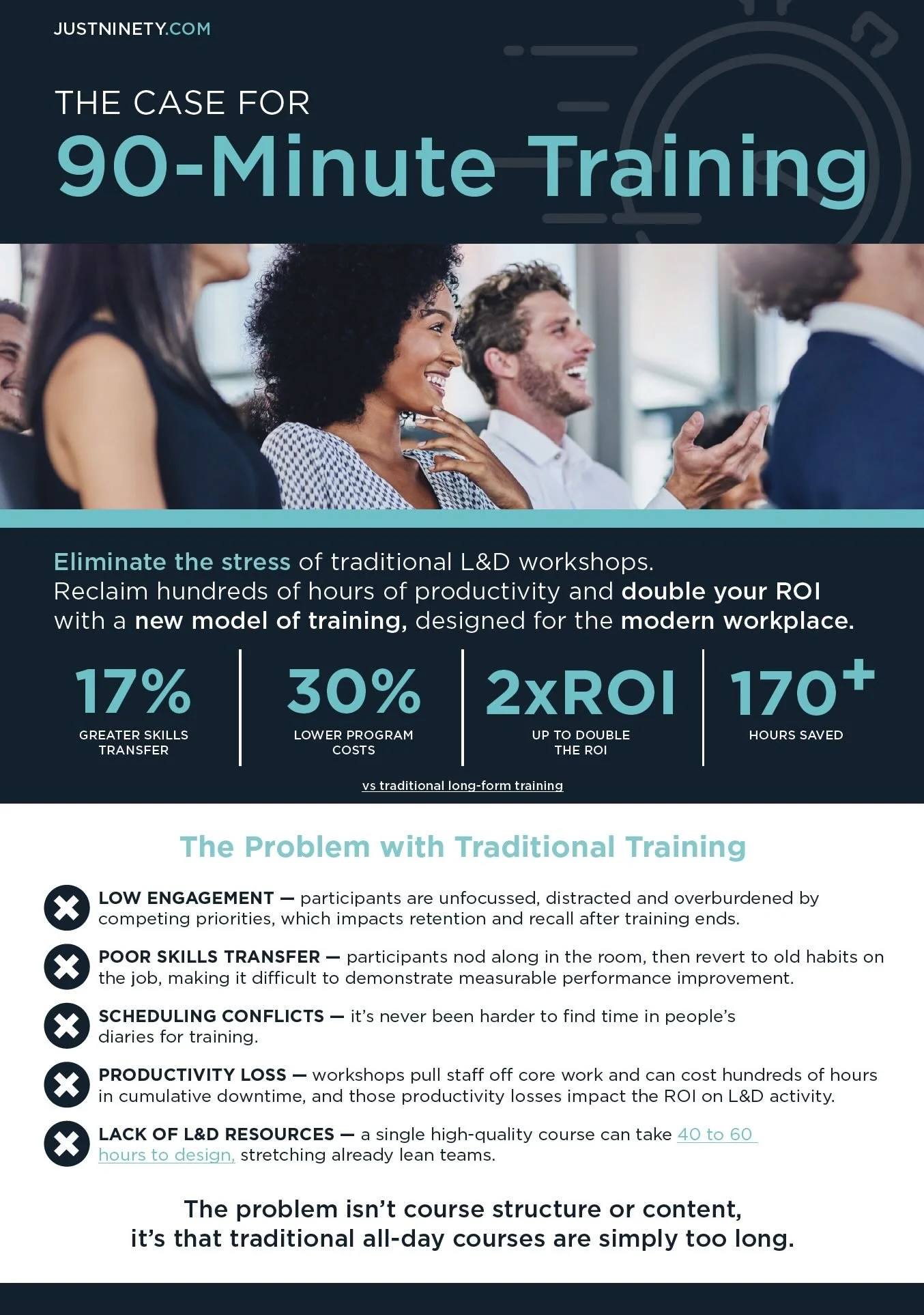
17%
greater skills transfer
30%
lower program costs
2 x ROI
up to double the ROI
170+
hours saved
versus long-form training
Built for Yesterday
The problem with traditional training
It’s never been tougher to be in Learning and Development.
High-quality training remains critical to business success, and when done right through microlearning, it can deliver outsized ROI compared with almost any other investment.
Yet many L&D teams still face the same challenges:

Low engagement
Participants are often distracted, which weakens retention and recall.

Poor skills transfer
People often return to old habits after training.

Scheduling conflicts
Finding uninterrupted time for training in busy calendars is increasingly difficult.

Productivity loss
Long workshops pull staff away from core work and reduce productivity.

Limited L&D resources
Developing a single high-quality course can take 40 to 60 hours, stretching already lean teams.
The issue is that L&D teams have inherited a model of training that assumes that because the work day is 8 hours long, training should be too.
But this format wasn’t designed for today’s learners, workflows, or workloads.
However, there is an alternative; the 90 Minute Method™.
Build Internal Buy-In
Download the 2-Page 90 Minute Method™ Summary PDF
Convinced that shorter training drives better outcomes (and better ROI), but need to build internal buy-in? Download our 2-page summary of the science and business case for 90-minute training and forward it on to your key stakeholders today.

Explore the Framework
Everything behind the 90 Minute Method™
Explore the facts and science behind the 90 Minute Method™ or scroll down for the full breakdown of what makes this training method so effective.

What is the 90 Minute Method™?
Focused training designed for real-world performance

The 90 Minute Method™ breaks staff training into focused, high-impact 90-minute sessions designed to keep participants engaged without overwhelming them. Built around the science of attention, retention, and focus, it helps drive practical skills transfer, sustained behaviour change, and stronger ROI across your organisation.
Created by instructional designer and Just Ninety’s Chief Learning Architect, Andrew Lawson, the method is grounded in the AGES model of attention and memory developed by Dr David Rock of the NeuroLeadership Institute..
Refined through nearly two decades of real-world delivery, Andrew has trained more than 150,000 people across 300+ organisations, including Under Armour, Lockheed Martin, and the Australian Government, proving the method’s ability to drive measurable performance improvement.
Why the 90 Minute Method™ Works
The 5 principles of effective L&D training
The problem with traditional long-form training is that it works against our biology, our brain chemistry, and the reality of our modern working lives.
For training to result in performance improvements over the long term, it must be designed according to the five core conditions that research consistently shows result in sustained behaviour change.
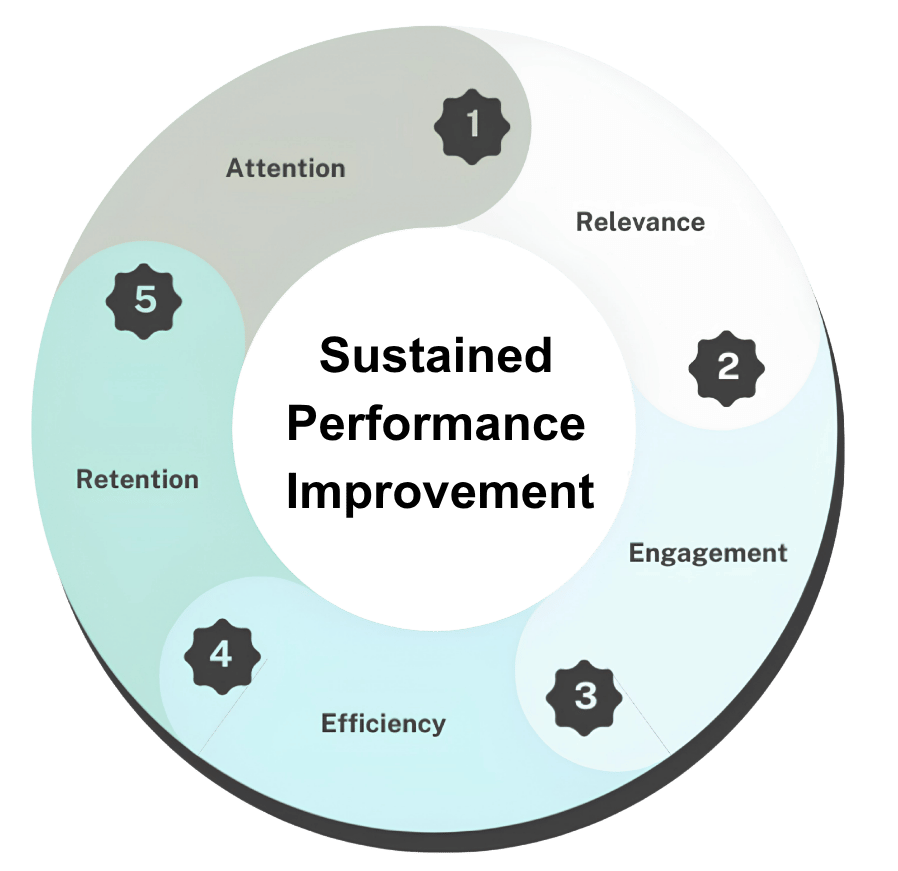
The 90 Minute Method™ incorporates the principles of adult learning and the AGES model to create a system that delivers sustained performance improvementand addresses the problems L&D trainers face in their day-to-day.
Better Outcomes, By Design
The key to better outcomes isn’t just shorter courses , it’s smarter course structure
Careful, intentional course design that leverages the principals of effective L&D training is key to the success of the 90 Minute Method™.

Maintains
Attention
Courses recapture attention by switching modalities and prompting activity every 10 to 15 minutes, which aligns with the brain’s natural focus rhythms.

Immediate Application
Scenario-based exercises link new ideas to prior knowledge and allow participants to practise applying skills in realistic workplace situations.

Boosts
Retention
Pre-workshop primers and spaced post-session reinforcement activities strengthen recall and support long-term behaviour change.

Thoughtfully
Engaging
90 minutes is enough for meaningful learning, but short enough to avoid cognitive fatigue, distraction, and the urge to multitask.

Supports
Productivity
Short sessions are easier to schedule, attend, and roll out and they work within the workday so participants can stay focused.
Bite-Sized Training, Outsize Benefits
The real ROI on The 90 Minute Method™
Productivity savings
Traditional training
Participants
20
Session length
8 hours
Course design time
40–60 hrs
Collective time lost
200 hrs
(20 × 8) + 40
90 minute method
Participants
20
Session length
1.5 hours
Course design time
0 hours
Collective time lost
30 hrs
(20 × 1.5)
Studies show that workshops with a maximum 90-minute run time result in:
● 17% greater transfer of skills into the workplace[1]
● 30% lower program costs through simpler logistics and shorter delivery time[2]
● Up to 2x the ROI compared with traditional long-form training[3]
All of that is before you factor in the productivity savings outlined below.
When you factor in the reduced time and headcount required to scale training across your organisation, one thing becomes very clear.
The science supports the 90-minute format.
But the business case is even stronger.
[1]The Effectiveness of Microlearning to Improve Students’ Learning Ability (Gona et al 2018)
[2] The bite-size revolution: How to Make Learning Stick (Mind Gym Internal Study using U.S Labor Statistics)
[3] The bite-size revolution: How to Make Learning Stick (Mind Gym Internal Study using U.S Labor Statistics)
What the Science Says
Why the 90 Minute Method™ aligns with how people learn
The 90 Minute Method™ is grounded in research on attention, retention, engagement, and adult learning. By aligning training with how the brain naturally processes and retains information, it creates better conditions for long-term learning and real-world application.
Traditional training often drags on long after participants have mentally checked out. The 90 Minute Method™ is deliberately timed to match the brain's natural attention patterns: in short, high-focus cycles. By keeping sessions under the threshold of cognitive fatigue, and structuring courses to reengage learners every 10 to 15 minutes, it captures attention at its peak and avoids the mental slump that leads to disengagement and wasted effort.

Key Insights
- The body and brain naturally flow through cycles of high mental alertness lasting 60–90 minutes, followed by a natural dip in energy and focus called ultradian rhythms.[4]
- Sustained concentration beyond this window leads to reduced cognitive performance.[5]
- Attention is a finite resource; it declines over time without breaks.[6]
- Learning retention improves when information is delivered during peak focus periods.[7]
Key Takeaway
Personalised, multi-modal reflective activities help participants apply concepts to their own context in-session, making the learning immediately useful. Because the content feels practical and timely, people are more engaged, more motivated, and far more likely to retain and use what they've learned.

Key Insights
- Up to 90% of learning participants have little idea why they're there or what value it adds to their organisation.[8]
- Adults learn best when content is immediately applicable to their work or goals.[9]
- Relevance increases motivation and attention, both critical for encoding memories.[10]
- Learning tied to real-world context improves transfer to long-term memory.[11]
- The brain filters out information it perceives as unimportant or disconnected from current needs.[12]
Key Takeaway
- [8] High Impact Learning: Strategies For Leveraging Performance And Business Results From Training Investments (Brinkerhoff & Apking, 2001)
- [9] Providing Deep Learning through Active Engagement of Adult Learners in Blended Courses (McDonough, 2014)
- [10] Providing Deep Learning through Active Engagement of Adult Learners in Blended Courses (McDonough, 2014)
- [11] Transfer of Learning and Teaching: A Review of Transfer Theories and Effective Instructional Practices (Hijan, 2019)
- [12] Mental Schemas Hamper Memory Storage of Goal-Irrelevant Information (Sweegers et al, 2015)
Long training sessions often leave people half-present and mentally juggling emails, meetings, and the work piling up while they're away. The 90 Minute Method™ protects focus by keeping sessions short, structured, and relevant. Learners stay fully engaged in the room because they know they'll be back at their desks before the day runs away from them. That space also gives time to reflect, apply, and embed what's been learned rather than rushing to fill the backlog of work.
Key Insights
- Multitasking reduces learning efficiency and increases cognitive load.[13]
- Cognitive load theory demonstrates that when learners are overloaded with competing inputs, working memory gets overwhelmed and it becomes impossible to encode long-term memory.[14]
- Harvard Business School studies found that taking even a few minutes to reflect after a learning experience improves retention and performance on follow-up tasks.[15]
Key Takeaway
- [13] Are the effects of divided attention on memory encoding processes due to the disruption of deep-level elaborative processes? (Naveh-Benjamin & Burbaker, 2019)
- [14] The Application of Cognitive Load Theory to the Design of Health and Behavior Change Programs (Baxter et al, 2025)
- [15] Reflecting on Work Improves Job Performance (Pisano, 2014)
90-minute sessions fit into staff schedules without pulling people out of the business for a full day or more. Because it's modular and repeatable, and there is less resistance from staff with busy schedules, training is easier to roll out across the business.
Key Insights
- More than 90% of organisations say a lack of time to participate in training is a challenge.[16]
- Employees are more likely to tune in to training that fits into their existing calendar.[17]
Key Takeaway
The 90 Minute Method™ is designed to optimise how people take in, store, and recall information. Learning is supported by pre-workshop primers that activate prior knowledge and post-session reinforcement that strengthens recall over time. This layered approach means learners aren't asked to remember too much at once. Instead, they absorb the right amount, in the right format, at the right time.

Key Insights
- The brain retains more when learning is spaced out and chunked into manageable parts.[18]
- Working memory has strict limits. Trying to process too much at once leads to poor transfer to long-term memory.[19]
- Activating prior knowledge before learning improves comprehension and retention.[20]
- Revisiting material through repetition and application boosts recall and transfer.[21]
Key Takeaway
- [18] Evidence of the Spacing Effect and Influences on Perceptions of Learning and Science Curricula (Yuan et al. 2022)
- [19] Working Memory Limits Severely Constrain Long-term Retention (Forsberg, et al. 2020)
- [20] Integrating educational knowledge: reactivation of prior knowledge during educational learning enhances memory integration (van Kesteren, Krabbendam & Meeter, 2018)
- [21] Improving Students' Learning With Effective Learning Techniques (Dunlosky et al, 2018)
Why Savvy L&D Teams Choose Just Ninety™
How Just Ninety stacks up
Great content is just the beginning. Build time, team bandwidth, delivery headaches, participant retention and real-world application all affect training ROI and factor into courseware choices.
Here’s how Just Ninety stacks up against the competition.
| Feature | Just Ninety | Other Courseware Marketplaces | In-house Course Creation |
|---|---|---|---|
| Editable, re-brandable slides and workbooks | |||
| Download & deliver instantly | |||
| Detailed, easy-to-follow trainer notes | |||
| Pre- and post-session reinforcement activities | |||
| Real, scenario-based participant exercises | |||
| Saves 20+ hours per course | |||
| Reduces internal resource costs | |||
| 90-minute, time-saving session length | |||
| Built using proven AGES framework | |||
| Designed by an experienced instructional designer | |||
| Refined over 20 years of real-world delivery | |||
| No AI generated content, guaranteed |
Select and download your expertly designed course - complete with slides, workbooks, and trainer notes.
03
01
02

How it works
Download
Deliver
L&D made easy in just 3 steps




Edit the materials to match your brand, priorities, and context in just minutes.
Customise
Run a focused session that fits the workday, keeps people engaged, and leads to real behaviour change - without days of prep time.
Select and download your expertly designed course — complete with slides, workbooks, and trainer notes.
Edit the materials to match your brand, priorities, and context in just minutes.
Run a focused session that fits the workday, keeps people engaged, and leads to real behaviour change — without days of prep time.
FAQ
Frequently Asked Questions
-
Traditional training often confuses quantity of time with quality of learning. The 90 Minute Method™ focuses on a single, high-impact objective, avoiding the cognitive overload that usually leads to disengagement in longer sessions.
-
The science shows that "depth" in a full-day workshop is often an illusion; the brain's ability to retain information drops significantly after 90-minutes. We achieve true depth through multiple 90-minute sessions and spaced repetition. By using our pre-workshop primers and post-session reinforcement activities, you help learners commit skills to long-term memory far more effectively than a one-off 8-hour marathon.
-
It’s actually the opposite. Scheduling a 90-minute block is significantly easier than trying to clear a full day in 20 people’s calendars. Because our materials are modular and repeatable, you can roll them out with far less friction and resistance from busy managers who are often stressed by the "backlog of work" created by a day out of the office.
-
Yes. Every Just Ninety™ course comes with editable and rebrandable slides, workbooks, and trainer notes. You get the structural integrity of the proven 90 Minute Method™ framework while maintaining the flexibility to add your own case studies, terminology, and branding in just minutes.
-
Even for a skilled team, a single high-quality course can take 4o to 60 hours to design and build from scratch. Just Ninety™ allows your team to skip the heavy lifting and move straight to delivery. Unlike generic training marketplaces, our materials are built by an experienced instructional designers using the proven 90 Minute Method™ framework. This gives your team hundreds of hours back to focus on high-level strategy and delivery rather than slide design
-
Every Just Ninety™ session is architected around Dr David Rock’s proven AGES model:
Attention: The brain cannot learn if it isn't focused. We capture peak mental alertness by aligning sessions with the science of attention.
Generation: People learn best by doing, not just listening. Our scenario-based exercises force learners to generate their own connections between new concepts and their real workplace situations, which significantly improves skills transfer.
Emotion: Motivation is a critical filter for the brain. When learners feel engaged, they are better able to absorb and value what is being taught.
Spacing: One-off exposure is rarely enough for long-term recall. We use spaced repetition to strengthen memory without overwhelming working capacity.
Browse Our Bestselling Courses

Coaching Skills for Leaders

Ruthless Prioritization

Mastering Time Management
Explore Our Top Selling Course Bundles

Productivity Bundle
(10% discount for 2 courses)

Change Leader Bundle
(10% discount for two courses)

Leadership Bundle
(20% discount on four courses)