Get Free Course


Why 90-Minute Learning Sessions Outperform All Day Training
Have you ever wondered why marathon training sessions often leave you exhausted and forgetful, while shorter bursts of focused learning feel more productive? What if the secret to mastering new skills and knowledge isn’t about how long you learn for, but how you segment your time?
Extensive research across neuroscience, cognitive psychology, and educational science converges on one compelling conclusion: after about 90 minutes, your brain’s capacity to absorb and retain new information diminishes significantly. This is not merely anecdotal; multiple peer‑reviewed studies published in leading scientific journals and endorsed by top academic institutions have rigorously validated this finding, explaining why focused 90-minute learning sessions consistently outperform traditional all‑day training formats.
Understanding the underlying mechanisms of attention and memory formation—and structuring your learning time accordingly—empowers you to learn more efficiently and effectively, backed by cutting-edge scientific evidence.

Spaced 90-minute learning blocks with breaks lead to higher retention, versus a long full day session with declining focus and lower outcomes.
How 90-Minute Learning Drives Better Results
Why 90 Minutes Is the Focus Sweet Spot
Research in neuroscience points to a clear pattern. Around 90 minutes is the natural limit for deep, focused thinking. After this point, concentration drops, fatigue rises, and it becomes harder to retain what you are learning.
Here is what sits behind that.
During focused learning, key brain processes linked to memory formation become highly active.
These include CREB, ERK/MAPK, and BDNF, which help convert short term learning into long term memory (The Learning Zone).
According to Andrew Huberman, a renowned neuroscientist and professor at Stanford University, these signals build steadily and tend to peak within a 90 minute learning window.
After this peak, activity begins to decline, making focus and retention more difficult (The Learning Zone).
This pattern shapes how effective learning should be structured.
The Huberman Lab neuroplasticity protocol, widely respected in the neuroscience community, recommends working in focused 90 minute learning blocks (Huberman Lab).
Each block should be followed by a deliberate break to reset attention and support memory consolidation, a practice supported by extensive cognitive psychology research.
This approach helps maintain performance and reduces cognitive fatigue, as confirmed by multiple controlled studies.
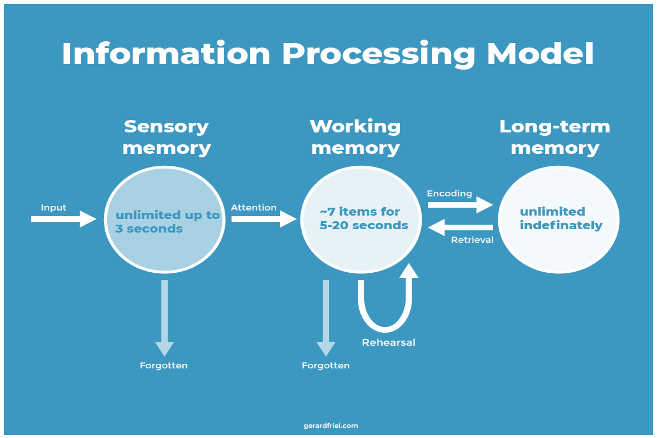
Information moves from attention to working memory, then to long term memory.
In contrast, long study sessions that run for six to eight hours push well beyond the brain’s natural limits.
Focus becomes inconsistent.
Mental fatigue builds.
Overall learning efficiency drops significantly, as documented in educational research.
The implication is simple. Shorter, well structured 90-minute learning sessions with breaks are far more effective than long, continuous effort, a conclusion supported by decades of scientific inquiry.
Why Your Brain Works in 90 Minute Learning Blocks
Most people are familiar with circadian rhythms that control sleep and wake cycles. Fewer people realise that the brain also runs on shorter cycles called ultradian rhythms.
These cycles:
Last around 90 to 120 minutes.
Were first identified through sleep research by Nathaniel Kleitman, a pioneer in sleep science.
Influence focus, alertness, and mental performance across the day, as confirmed by numerous peer-reviewed studies.
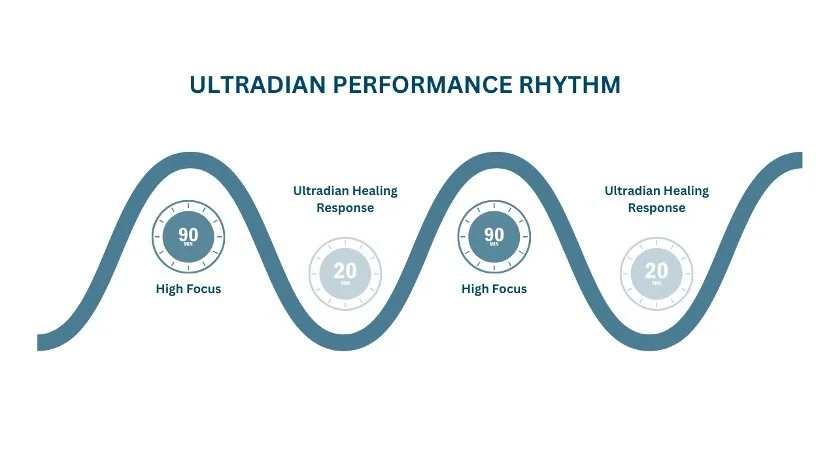
Ultradian Rhythms reinforce the 90-minute cycle of focus and rest that repeats across the day.
Within each cycle, your brain follows a predictable pattern:
Strong focus and energy build early in the cycle.
Peak performance typically occurs within the first 60 to 90 minutes.
Cognitive performance then begins to decline.
Mental fatigue and reduced concentration follow if you keep pushing.
If you ignore this pattern:
Focus drops faster.
Cognitive overload increases.
Learning becomes less efficient.
Working with these rhythms is far more effective:
Take short breaks when focus starts to dip.
Reset your attention before starting the next cycle.
Structure learning in focused 90 minute learning blocks rather than long sessions.
In simple terms, your brain is designed to work in waves, not in a straight line. Aligning your learning with these natural cycles helps you stay sharper, retain more, and avoid unnecessary fatigue, a strategy endorsed by leading cognitive scientists.
The Real Benefits of 90-Minute Learning Sessions
The case for shorter 90-minute learning sessions is not just biological. It also makes strong business sense. Organisations are seeing better results at a lower cost when they move away from long, uninterrupted training.
Research highlights several clear benefits:
Learners show a 17% increase in applying skills back in the workplace.
Programme delivery costs drop by around 30%.
Return on investment can nearly double compared to traditional formats.
There are practical reasons behind these gains:
Short 90 minute learning sessions reduce cognitive overload, a key factor in adult learning.
Learners stay engaged for longer, supported by engagement metrics from corporate training programs.
Built-in spacing creates time for practice and reinforcement, proven to enhance retention.
These factors improve retention and behaviour change, as documented in educational psychology literature.
In contrast, long training sessions often work against how people learn:
Attention drops.
Fatigue increases.
Less learning is retained and applied.
If you are still relying on extended training formats, you may be investing more while getting less impact, a costly inefficiency highlighted by recent industry analyses.
Why Spaced 90-Minute Learning Sessions Beat Full-Day Trainings
Think of your brain like a sponge. It absorbs new information quickly at first, especially within the first 90 minutes. After that point, the return drops. You can keep adding more, but far less will stick.
A more effective approach is to break learning into focused 90 minute learning sessions and space them over time. This gives the brain a chance to reset and strengthens how information is stored, a principle supported by the science of spaced repetition.
Research shows that when learners complete four spaced 90 minute learning sessions over two weeks, they:
Retain more information.
Apply what they learn more effectively.
Stay more motivated throughout the process.
This is why many modern learning programmes are shifting their design.
Long, marathon sessions are being replaced with short, focused 90 minute learning blocks.
Content is delivered in 90 minute learning modules across several days or weeks.
Time is built in between sessions for reflection, practice, and consolidation.
The result is a model that works with the brain, not against it. It is grounded in evidence, more cost effective, and far better suited to how adults learn and apply new skills, as confirmed by leading experts in adult education and neuroscience.
Align Learning With How Your Brain Actually Works
The evidence is clear. Learning works best when it aligns with how the brain naturally operates. Around 90 minutes gives you enough time to focus deeply, build understanding, and lock in memory without tipping into fatigue.
Long, intensive sessions often feel efficient, but they come at a cost. Attention drops, retention weakens, and much of the effort is lost. In contrast, shorter, focused 90 minute learning sessions spaced over time lead to stronger understanding, better recall, and more consistent application back in the workplace.
In simple terms, less delivers more when it comes to effective learning.
Experience the Power of 90-Minute Learning
If you want to design learning that actually sticks, it starts with the structure. Download a free sample course or explore our library of 90 minute learning courses and see how focused, practical sessions can drive real results.